Gold Ira Home Storage – Everything You Need to Know in 2026

A Gold IRA, also known as a precious metals IRA, is a specialized type of Individual Retirement Account that allows investors to hold physical gold and other approved precious metals as part of their retirement portfolio. Unlike traditional IRAs that typically contain paper assets such as stocks, bonds, and mutual funds, a Gold IRA provides the opportunity to diversify retirement savings with tangible assets that have maintained value throughout human history. Chances are you were looking for – Gold Ira Home Storage, but you need to know this first.

Gold IRAs operate under the same tax-advantaged structure as conventional IRAs, meaning contributions may be tax-deductible, and the assets grow tax-deferred until withdrawal during retirement. This investment vehicle has gained significant popularity among investors seeking to protect their retirement savings from economic uncertainty, inflation, and market volatility.

The concept of including precious metals in retirement accounts became possible through the Taxpayer Relief Act of 1997, which expanded the types of assets permissible in IRAs. Since then, Gold IRAs have become an increasingly important tool for retirement planning, particularly for those who value portfolio diversification and wealth preservation.

Table of Contents show

Types of Gold IRAs

Traditional Gold IRA

A Traditional Gold IRA functions similarly to a standard traditional IRA but holds physical precious metals instead of paper assets. Contributions to a Traditional Gold IRA may be tax-deductible depending on your income level and whether you’re covered by an employer-sponsored retirement plan. The assets within the account grow tax-deferred, and you’ll pay ordinary income taxes on distributions taken during retirement. Required Minimum Distributions (RMDs) typically begin at age 73, following current IRS regulations.

Roth Gold IRA

A Roth Gold IRA is funded with after-tax dollars, meaning contributions are not tax-deductible in the year they’re made. However, the significant advantage is that qualified distributions during retirement are completely tax-free, including all growth and appreciation of your precious metals holdings. Roth Gold IRAs do not have required minimum distributions during the account holder’s lifetime, providing greater flexibility in retirement planning.

SEP Gold IRA

A Simplified Employee Pension (SEP) Gold IRA is designed for self-employed individuals and small business owners. SEP IRAs allow for higher contribution limits compared to traditional and Roth IRAs, making them an attractive option for those with higher incomes who want to maximize their retirement savings in precious metals. Employers make contributions on behalf of eligible employees, and these contributions are tax-deductible as a business expense.

Eligible Precious Metals for Gold IRAs

The IRS maintains strict standards regarding which precious metals can be held in a Gold IRA. These requirements ensure that only high-quality, investment-grade metals are included in retirement accounts.

Gold Requirements

Gold products must meet a minimum fineness requirement of .995 purity (99.5% pure). Acceptable gold products include certain bullion bars and coins from approved refiners and government mints. American Gold Eagle coins are an exception to the purity rule and are permitted despite being 91.67% pure due to their status as official U.S. legal tender.

Silver Requirements

Silver must meet a minimum fineness of .999 (99.9% pure). Approved silver products include various bullion bars and coins that meet IRS specifications.

Platinum and Palladium Requirements

Both platinum and palladium must meet a minimum fineness of .9995 (99.95% pure). These metals provide additional diversification options within a precious metals IRA.

Prohibited Items

Collectible coins, rare numismatic coins, and jewelry are generally not permitted in Gold IRAs. The IRS specifically prohibits items valued primarily for their collectibility rather than their precious metal content. Additionally, certain commemorative coins and limited mintage items may not qualify, even if they meet purity standards.

How Gold IRAs Work

The Self-Directed IRA Structure

Gold IRAs are structured as self-directed IRAs, which means the account holder has greater control over investment decisions compared to traditional IRAs managed by financial institutions. While you direct the investments, you’ll still work with several specialized service providers to maintain IRS compliance.

Required Service Providers

Custodian: An IRS-approved custodian must hold legal ownership of the IRA assets on your behalf. The custodian handles all administrative tasks, maintains records, files required reports with the IRS, and ensures compliance with regulations. Not all IRA custodians handle precious metals, so you’ll need to work with one specializing in Gold IRAs.

Dealer: A precious metals dealer sources and sells the gold and other precious metals for your IRA. The dealer should offer IRA-eligible products and work seamlessly with custodians to facilitate purchases.

Depository: IRS regulations require that precious metals in an IRA be stored in an approved depository facility. You cannot store IRA-owned gold at home or in a personal safe deposit box. The depository provides secure, insured storage and maintains detailed records of your holdings.

Funding Your Gold IRA

There are several methods to fund a Gold IRA:

Direct Contributions: You can make annual contributions up to the IRS limit, which adjusts periodically for inflation. These contributions can be made with cash that the custodian then uses to purchase precious metals on your behalf.

Transfers: You can transfer funds from one IRA to another without tax consequences. The money moves directly between custodians without you taking possession of the funds.

Rollovers: You can roll over funds from qualified retirement accounts such as 401(k)s, 403(b)s, or traditional IRAs into a Gold IRA. Rollovers must be completed within 60 days to avoid taxes and penalties, though direct rollovers (trustee-to-trustee transfers) are generally recommended to avoid complications.

Benefits of Gold IRA Investing

Inflation Protection

Gold has historically served as a hedge against inflation. As the purchasing power of currency decreases over time, gold typically maintains or increases its value. During periods of high inflation, gold often outperforms traditional paper assets, helping preserve the real value of retirement savings.

Portfolio Diversification

Modern portfolio theory emphasizes the importance of diversification across different asset classes. Gold and other precious metals often have a low or negative correlation with stocks and bonds, meaning they may perform well when traditional investments struggle. This diversification can reduce overall portfolio volatility and risk.

Economic Uncertainty Protection

During times of economic turmoil, political instability, or financial market stress, gold frequently serves as a “safe haven” asset. Investors flock to gold during crises, often driving up its value when other investments are declining. This characteristic makes gold an important component of a defensive investment strategy.

Tangible Asset Ownership

Unlike stocks or bonds, which represent claims on company assets or debt obligations, gold is a physical asset with intrinsic value. This tangibility provides psychological comfort to many investors who appreciate owning something real rather than paper promises.

Long-Term Value Preservation

Gold has maintained its value across centuries and civilizations. While short-term prices fluctuate, gold’s long-term track record as a store of value is unmatched. This makes it particularly suitable for retirement planning, which requires a long-term perspective.

Tax Advantages

Gold IRAs offer the same tax benefits as traditional retirement accounts. Depending on the type of Gold IRA you choose, you can enjoy tax-deductible contributions, tax-deferred growth, or tax-free distributions in retirement.

Gold Ira Home Storage – Some Considerations

Costs and Fees

Gold IRAs typically involve higher costs than traditional IRAs. You’ll encounter setup fees, annual custodial fees, storage fees charged by the depository, and transaction fees when buying or selling metals. Additionally, precious metals dealers charge premiums over the spot price of metals. These costs can accumulate over time and impact overall returns.

However, they are totally worth it in the long run if you consider the ROI.

No Passive Income

Unlike dividend-paying stocks or interest-bearing bonds, gold does not generate income while you hold it. The only way to profit from gold is through price appreciation. This means your Gold IRA won’t benefit from the compounding effect of reinvested dividends or interest payments.

Price Volatility

While gold is often viewed as a stable store of value over the long term, short-term prices can be quite volatile. Gold prices are influenced by numerous factors including currency fluctuations, interest rates, geopolitical events, and investor sentiment. This volatility can be unsettling for some investors.

Liquidity Considerations

While gold is generally considered a liquid asset, selling physical gold from an IRA involves more steps than selling stocks or mutual funds. You must coordinate with your custodian and dealer, and the process may take several days. Additionally, you’ll need to find a buyer willing to pay a fair price.

Storage Limitations

IRS regulations prohibit storing IRA-owned gold at home. All precious metals must remain in an approved depository until you take a distribution. This requirement means you cannot directly access or enjoy your gold holdings while they’re in the IRA.

Required Minimum Distributions

For Traditional Gold IRAs, you must begin taking required minimum distributions at age 73. This means you’ll need to either sell some of your precious metals or take physical possession of them (which counts as a taxable distribution). The need to liquidate holdings to satisfy RMDs can be problematic if gold prices are depressed at that time.

Setting Up a Gold IRA: Step-by-Step Process

Step 1: Research and Education

Before opening a Gold IRA, invest time in understanding how these accounts work, the costs involved, and whether they align with your retirement goals. Consider consulting with a financial advisor who understands precious metals investing.

Step 2: Choose a Custodian

Select an IRS-approved custodian that specializes in precious metals IRAs. Compare fee structures, customer service reputations, and the range of services offered. The custodian will be your primary point of contact for account administration.

Step 3: Complete Account Application

Fill out the necessary paperwork to establish your Gold IRA. This process is similar to opening any other IRA and requires personal information, beneficiary designations, and investment objectives.

Step 4: Fund Your Account

Decide how you’ll fund the account-through contributions, transfers, or rollovers. If rolling over funds from an existing retirement account, work closely with both custodians to ensure a smooth, tax-free transfer.

Step 5: Select Your Precious Metals

Once your account is funded, work with your dealer to select IRA-eligible precious metals. Consider diversifying across different types of metals and products to maximize the benefits of precious metals ownership.

Step 6: Complete the Purchase

Your custodian will use funds from your IRA to purchase the selected metals from the dealer. The metals are then shipped directly to the approved depository, where they’ll be stored in your account.

Step 7: Ongoing Management

Monitor your account statements, track the value of your holdings, and rebalance as needed. Stay informed about precious metals markets and consider whether adjustments to your allocation are appropriate as you approach retirement.

Gold IRA Distribution Options

Taking Physical Possession

When you reach retirement age and want to access your Gold IRA assets, you can take physical possession of your precious metals. This counts as a taxable distribution (for Traditional Gold IRAs), and you’ll pay ordinary income taxes on the value of the metals received. The metals will be shipped from the depository to your address.

Selling for Cash

Alternatively, you can instruct your custodian to sell your precious metals and distribute the cash proceeds. This option provides liquidity and may be preferable if you need funds for living expenses rather than physical gold.

In-Kind Distribution

Some investors choose to take partial distributions of physical metals while leaving the remainder in the account. This strategy allows you to enjoy some of your gold holdings while maintaining tax-deferred growth on the balance.

Gold IRA Rules and Regulations

Contribution Limits

Gold IRAs are subject to the same annual contribution limits as traditional IRAs. These limits are adjusted periodically by the IRS to account for inflation. For 2024, individuals under 50 can contribute up to 7,000 annually, while those 50 and older can contribute up to 8,000 with the catch-up contribution.

Prohibited Transactions

The IRS prohibits certain transactions in Gold IRAs to prevent self-dealing and maintain the retirement purpose of these accounts. You cannot:

  • Store IRA-owned gold at home or in a personal safe deposit box
  • Use IRA gold as collateral for a loan
  • Sell personal precious metals to your IRA
  • Purchase metals from your IRA for personal use without taking a distribution

Violating these rules can result in the entire IRA being considered distributed, triggering immediate taxes and potential penalties.

Early Withdrawal Penalties

Distributions taken before age 59½ are generally subject to a 10% early withdrawal penalty in addition to ordinary income taxes. Certain exceptions exist, including disability, first-time home purchases (up to $10,000), and qualified education expenses.

Factors Affecting Gold Prices

Understanding what drives gold prices can help you make informed decisions about your Gold IRA investments.

Economic Indicators

Gold prices often respond to economic data such as inflation rates, GDP growth, and employment figures. Weak economic data typically supports gold prices as investors seek safe-haven assets.

Interest Rates

There’s generally an inverse relationship between interest rates and gold prices. When interest rates rise, the opportunity cost of holding non-yielding gold increases, potentially pressuring prices downward. Conversely, low interest rates make gold more attractive.

Currency Fluctuations

Gold is priced in U.S. dollars, so the strength or weakness of the dollar significantly impacts gold prices. A weaker dollar typically supports higher gold prices, while a stronger dollar can pressure prices lower.

Geopolitical Events

Political instability, conflicts, and international tensions often drive investors toward gold as a safe-haven asset, supporting prices during uncertain times.

Supply and Demand

Like any commodity, gold prices are influenced by supply from mining operations and demand from various sectors including jewelry, technology, and investment. Changes in mining output or demand from major consumers like China and India can affect prices.

Is a Gold IRA Right for You?

Ideal Candidates for Gold IRAs

Gold IRAs may be particularly suitable for:

  • Investors seeking portfolio diversification beyond traditional stocks and bonds
  • Those concerned about inflation eroding retirement savings
  • Individuals with a long investment time horizon who can weather short-term volatility
  • Investors who have already maximized contributions to other retirement accounts
  • Those with a portion of their portfolio they can dedicate to alternative investments without compromising their overall financial security

When a Gold IRA Might Not Be Appropriate

Gold IRAs may not be the best choice for:

  • Younger investors who can benefit more from the growth potential of stocks
  • Those with limited retirement savings who cannot afford the higher fees
  • Investors seeking regular income from their retirement accounts
  • Individuals who need maximum liquidity and flexibility
  • Those uncomfortable with commodity price volatility

Allocation Considerations

Financial experts generally recommend limiting precious metals to 5-10% of a diversified retirement portfolio. This allocation provides the benefits of gold ownership while maintaining sufficient exposure to growth-oriented assets. Your specific allocation should depend on your age, risk tolerance, retirement timeline, and overall financial situation.

[sspostsincat category=””]

Conclusion

Gold IRAs represent a unique opportunity to diversify retirement portfolios with physical precious metals while maintaining the tax advantages of traditional retirement accounts. These specialized IRAs offer protection against inflation, economic uncertainty, and market volatility, making them an attractive option for many retirement savers.

However, Gold IRAs are not without considerations. Higher fees, lack of passive income, and storage requirements mean they’re not suitable for everyone. The decision to open a Gold IRA should be made carefully, considering your overall financial situation, retirement goals, and investment philosophy.

By understanding how Gold IRAs work, the benefits they offer, and the potential drawbacks, you can make an informed decision about whether including precious metals in your retirement portfolio aligns with your long-term financial objectives. Whether you’re looking to hedge against economic uncertainty, diversify your holdings, or preserve wealth across generations, a Gold IRA may be a valuable component of a comprehensive retirement strategy.

As with any significant financial decision, consider consulting with qualified financial and tax professionals who can provide personalized advice based on your unique circumstances. With proper planning and realistic expectations, a Gold IRA can serve as an important tool in building a secure and diversified retirement portfolio.


>> Check out our top recommendation here

Gold IRA Home Storage – Best Options in 2025

Thinking about retirement? You’re not alone. Many investors are exploring different ways to secure their financial future, and Gold IRAs have become a popular option for those looking to diversify their retirement portfolios.

A secure home safe with gold bars and coins neatly organized inside

However, despite what some misleading advertisements might suggest, “Gold IRA Home Storage” is not a legitimate investment strategy for your retirement planning. The IRS requires precious metals in IRAs to be held by approved custodians, not in your personal possession at home.

Understanding the true requirements for Gold IRAs is essential for anyone serious about including precious metals in their retirement planning. Working with qualified custodians ensures your investment remains tax-compliant while still allowing you to pursue financial goals that include precious metals as a hedge against inflation and market volatility.

Understanding Gold IRAs

A secure home setting with a safe or vault prominently displayed, surrounded by images of gold bars, coins, and other precious metals

Gold IRAs offer investors a way to include precious metals in their retirement strategy. These specialized individual retirement accounts allow for diversification beyond traditional stocks and bonds, providing potential protection against economic uncertainty.

History and Fundamentals of Gold IRAs

Gold IRAs emerged after the Taxpayer Relief Act of 1997, which expanded allowable IRA investments to include certain precious metals. These accounts are structured as self-directed IRAs, giving investors more control over their retirement assets.

A Gold IRA is a type of individual retirement account that holds physical gold, silver, platinum, or palladium instead of paper assets. The IRS requires these metals meet specific purity standards: gold must be 99.5% pure, silver 99.9% pure, and platinum and palladium 99.95% pure.

Only IRS-approved coins and bullion qualify for inclusion. Popular options include American Gold Eagles, Canadian Gold Maple Leafs, and certain gold bars produced by approved refiners.

Unlike traditional investments, physical precious metals require secure storage at an IRS-approved depository. This ensures compliance with regulations while maintaining the tax advantages of an IRA.

Gold IRA vs. Traditional IRA: Key Differences

The primary distinction between Gold IRAs and traditional IRAs is the underlying assets. Traditional IRAs typically hold stocks, bonds, and mutual funds, while Gold IRAs contain physical precious metals.

Investment Objectives:

  • Traditional IRAs: Focus on growth and income generation
  • Gold IRAs: Emphasis on wealth preservation and portfolio diversification

Gold IRAs require a custodian specializing in precious metals, unlike traditional IRAs that work with conventional financial institutions. These specialized custodians understand the unique regulations governing precious metals investments.

Both account types offer similar tax advantages, including potential tax-deferred or tax-free growth depending on whether they’re structured as traditional or Roth accounts. However, Gold IRAs typically have higher fees due to storage and insurance requirements for physical metals.

Many investors use Gold IRAs as a partial diversification strategy rather than allocating their entire retirement portfolio to precious metals. This balanced approach helps protect against market volatility while maintaining growth potential.

Home Storage Gold IRA Explained

A secure home safe holds gold bars and coins, with a document explaining the concept of a Gold IRA

Home Storage Gold IRAs have gained attention as an alternative method for holding precious metals in a retirement account. This approach involves storing IRA gold at home rather than with a custodian, but comes with significant legal complexities and requirements.

The Concept of Home Storage for IRA Gold

A Home Storage Gold IRA refers to an arrangement where investors hold physical gold and other precious metals in their Individual Retirement Account while maintaining the assets at their personal residence. Traditional Gold IRAs require approved custodians and depositories to store the metals.

The appeal is straightforward: investors gain direct access to their physical gold while potentially maintaining tax advantages. Some companies market these arrangements as “checkbook IRAs” or “LLC IRAs.”

This approach typically involves creating a Limited Liability Company (LLC) owned by the IRA. The LLC then purchases and holds the gold, theoretically allowing the investor to store it personally.

Home storage advocates suggest this method gives investors greater control and reduces storage fees. However, the practical implementation faces several challenges.

Legal Considerations and IRS Rules

The IRS has strict rules regarding IRA assets, particularly concerning physical gold. IRS regulations clearly state that IRA assets must be held by a qualified custodian or trustee.

Section 408(m) of the Internal Revenue Code prohibits IRA investments in collectibles, including metals, with specific exceptions for certain gold, silver, platinum, and palladium products.

The IRS requires:

  • An approved custodian for all IRA assets
  • Proper segregation of IRA assets from personal property
  • Detailed record-keeping of all transactions

Warning: The IRS may consider home storage of IRA gold as a “distribution” of assets. This could trigger taxes and penalties of up to 10% for early withdrawals.

Several court cases have resulted in unfavorable outcomes for taxpayers who attempted to personally control IRA assets. The risk of IRS audit and potential disqualification of the entire IRA is significant.

Setting Up a Home Storage Gold IRA

To establish a compliant structure (though still legally questionable), several complex steps are required:

  1. Form a self-directed IRA with an approved custodian
  2. Create an LLC with proper operating agreements
  3. Open a business checking account for the LLC
  4. Transfer IRA funds to the LLC’s account
  5. Purchase IRS-approved precious metals

The LLC must maintain corporate formalities, including separate business records, regular meetings, and proper documentation. All transactions must benefit the IRA exclusively, not the individual.

Storage requirements include:

  • A secure, dedicated storage facility
  • Insurance coverage for the metals
  • Inventory tracking systems
  • Third-party verification

Most tax experts and financial advisors recommend extreme caution. The safer alternative is using established custodians and depositories for Gold IRAs, which ensures compliance with IRS regulations.

Security and Compliance Requirements

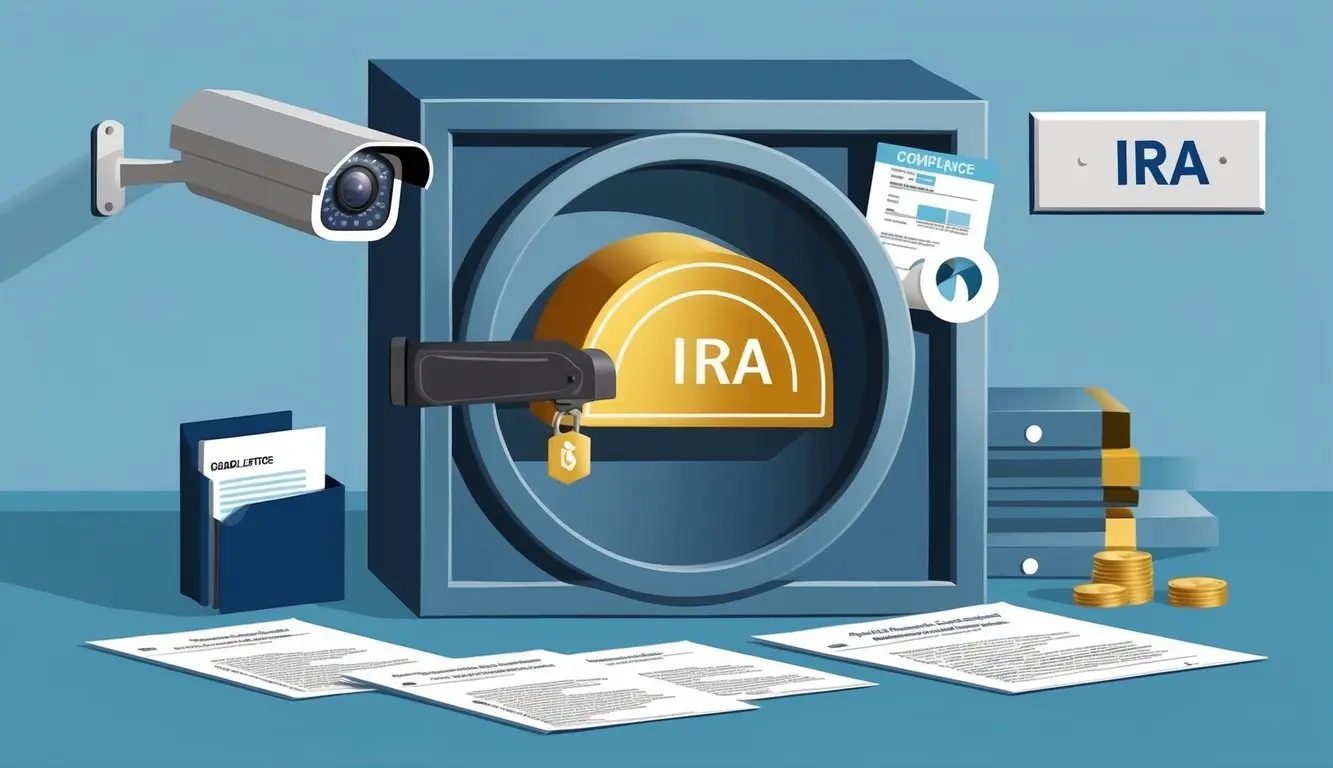
A secure vault with surveillance cameras and compliance documents for home storage of a Gold IRA

Storing precious metals at home requires strict adherence to security protocols and regulatory guidelines. Proper measures must be in place to protect your investment while satisfying IRS requirements.

Important Security Measures for Home Storage

A secure home storage setup for gold IRAs demands multiple layers of protection. Start with a commercial-grade safe that’s fireproof, waterproof, and bolted to the floor or wall. The safe should have a UL rating of at least TL-15 or TL-30, indicating it can withstand tool attacks for 15-30 minutes.

Install a comprehensive security system with 24/7 monitoring. This should include motion sensors, door/window alarms, and security cameras covering all entry points and the safe location.

Access control is crucial. Limit knowledge of your gold storage to trusted individuals only. Consider these additional measures:

  • Maintain an inventory list with photographs of each item
  • Install proper lighting around storage areas
  • Use decoy safes to mislead potential thieves
  • Avoid discussing your gold investments publicly

Insurance and Liability Aspects

Standard homeowners insurance typically provides minimal coverage for precious metals. Special riders or separate policies are necessary for adequate protection of gold IRA assets.

Specialized precious metals insurance offers comprehensive coverage against theft, damage, and natural disasters. These policies typically require:

  • Detailed inventory documentation
  • Proof of purchase and authenticity
  • Professional appraisals
  • Evidence of proper security measures

Insurance costs vary based on the value stored, security systems in place, and your location. Expect to pay 0.5% to 1.5% of the total metal value annually.

Be aware of liability issues. Self-storage creates personal responsibility for your assets. Without a professional custodian, you lack the protection of their fidelity bond, which insures against employee theft or fraud.

Regulatory Compliance and Audits

The IRS maintains strict rules for home-stored gold IRAs. Your setup must function like a legitimate business entity with:

  • A separate LLC or other business structure
  • Dedicated business bank account
  • Proper operating agreement
  • Annual reporting to the IRS

Regular audits are mandatory. You must conduct yearly valuations of all precious metals and report them accurately on IRS Form 5498. This requires:

  • Detailed inventory records
  • Professional appraisals when needed
  • Documentation of all transactions

Failure to comply with regulations can result in severe penalties. The IRS may disqualify your entire IRA, treating it as a full distribution and triggering taxes and early withdrawal penalties.

Most financial experts recommend working with a qualified custodian rather than attempting home storage due to these complex compliance requirements.

Investment Considerations

A secure home safe with gold bars and coins, alongside investment documents and a calculator

Gold IRAs offer a way to diversify retirement portfolios with physical precious metals. Understanding both the benefits and drawbacks is essential before deciding if home storage options align with your financial goals.

Advantages of Gold Investment

Gold serves as a hedge against inflation when paper currencies lose value. During economic uncertainty, precious metals often maintain purchasing power while other assets decline.

Physical gold has a long history of retaining value over centuries. Unlike paper assets, it cannot be printed or digitally created, giving it intrinsic worth.

Adding gold to an investment portfolio can reduce overall volatility. When stocks fall, gold frequently moves in the opposite direction, helping to balance potential losses.

Tax advantages exist when holding gold in a properly structured IRA. Potential tax-deferred growth or tax-free distributions (with Roth IRAs) make precious metals more attractive for retirement planning.

Risks and Downsides of Home Storage IRAs

IRS compliance issues represent the biggest danger with home storage arrangements. The IRS requires precious metals to be held by approved custodians, not personally stored.

Improper storage could trigger immediate taxes and penalties. The entire IRA might be considered distributed if the IRS determines you have personal control of assets.

Insurance challenges arise with home storage. Most homeowner policies don’t adequately cover valuable metals, creating significant financial risk.

Security concerns cannot be overlooked. Home-stored precious metals become targets for theft without professional vault protections.

No reputable custodians support true home storage options. Companies promoting these schemes often misrepresent IRS regulations.

Facilitating Liquidity and Accessibility

Gold IRAs typically offer lower liquidity than traditional investments. Converting physical gold to cash requires finding buyers and potentially paying dealer fees.

Established custodians provide streamlined selling processes. They maintain relationships with wholesalers who purchase metals at competitive rates.

Accessibility varies by storage arrangement. Depository storage offers security but requires formal procedures to view or withdraw assets.

Many legitimate custodians allow scheduled visits to inspect your precious metals. This provides peace of mind without compromising security or IRS compliance.

Emergency access should be considered in your planning. Understanding the procedures for quick liquidation during financial hardships helps avoid unexpected delays.

Strategic Planning for Retirement

A cozy living room with a secure safe hidden in a wall, surrounded by financial documents and retirement planning materials

Planning for your retirement requires careful thought about your financial needs and the best investment vehicles to meet your goals. A well-designed strategy includes considering various assets, including precious metals, to create a balanced portfolio that can withstand market fluctuations.

Diversification and Asset Allocation

Diversification remains a cornerstone of sound retirement planning. Spreading investments across different asset classes helps protect savings from market downturns in any single sector.

Gold IRAs can serve as an important component in a diversified portfolio. They often move independently of stocks and bonds, potentially providing stability when traditional markets falter.

Experts typically recommend allocating 5-15% of retirement assets to precious metals. This percentage varies based on:

  • Age and retirement timeline
  • Overall portfolio size
  • Economic outlook
  • Personal financial goals

A properly diversified retirement portfolio might include:

Asset Type Typical Allocation Range
Stocks 40-60%
Bonds 20-40%
Real Estate 5-15%
Precious Metals 5-15%
Cash 3-10%

Aligning Gold IRA with Financial Goals

Financial goals provide the framework for all investment decisions. When considering a Gold IRA, investors should clarify what role precious metals will play in their broader strategy.

Some investors use Gold IRAs primarily as wealth preservation tools. These individuals prioritize protecting their purchasing power over generating high returns.

Others incorporate Gold IRAs as hedges against inflation or currency devaluation. This approach works best when combined with growth-oriented investments elsewhere in the portfolio.

The timeline to retirement significantly influences gold allocation decisions. Younger investors may allocate smaller percentages to precious metals, while those nearing retirement might increase their allocations for stability.

Regular portfolio reviews help ensure Gold IRA investments remain aligned with changing financial goals. Most financial advisors recommend reassessing allocation at least annually.

Assessing Risk Tolerance and Market Volatility

Understanding personal risk tolerance is essential when incorporating Gold IRAs into a retirement strategy. Each investor must honestly evaluate their comfort with price fluctuations.

While gold is often considered a “safe haven” asset, its price can still experience significant volatility. During the 2008 financial crisis, gold initially dropped before climbing substantially in the following years.

Historical data shows gold often performs differently from stocks during periods of market stress:

  • During the 2000-2002 market decline, gold gained 12.4% while the S&P 500 fell 47.6%
  • In 2008, gold ended the year up 5.8% while the S&P 500 dropped 38.5%

Market conditions significantly impact gold’s performance. Factors that typically support higher gold prices include:

  • Rising inflation
  • Political uncertainty
  • Currency weakness
  • Low real interest rates

Investors should assess their emotional reaction to seeing gold prices fluctuate before committing substantial retirement funds. Those who panic during downturns may need to adjust their allocation.

Gold IRA Operational Mechanisms

A secure home safe holds gold bars and coins for a Gold IRA

Gold IRAs operate through specific structures and requirements that investors must understand to properly manage their precious metals retirement accounts. These accounts combine tax advantages with the security of physical gold investments.

The Role of Custodians and Trustees

Gold IRAs require a qualified custodian to oversee the account, unlike traditional IRAs. The custodian is a financial institution approved by the IRS to hold the retirement assets on behalf of the account owner.

Custodians handle all administrative duties including:

  • Processing transactions
  • Maintaining records
  • Filing required IRS reports
  • Ensuring compliance with regulations

Trustees often work alongside custodians but focus on different responsibilities. While custodians physically manage the assets, trustees provide oversight and ensure the account meets legal requirements.

The IRS strictly mandates that precious metals in a Gold IRA must be held by an approved custodian. This creates a separation between the investor and their assets, which maintains the tax-advantaged status of the account.

Storage Options: Allocated vs. Segregated

Gold IRA investors must understand two primary storage methods: allocated and segregated storage.

Allocated storage means your specific gold coins or bars are identified by serial numbers and kept separate from other investors’ holdings. This option provides:

  • Greater security
  • Complete ownership of specific metal pieces
  • Easy verification of your exact holdings

Segregated storage offers the highest level of protection. In this arrangement, your precious metals are:

  • Stored in a completely separate section of the vault
  • Never mixed with other investors’ assets
  • Often secured with additional protections

Most reputable custodians use specialized depositories with advanced security systems. These facilities typically offer insurance coverage for stored metals, providing additional protection against theft or damage.

Understanding the LLC Structure in Home Storage

Some investors explore using a Limited Liability Company (LLC) structure for “home storage” Gold IRAs. This arrangement involves:

  1. Creating an LLC that the IRA owns
  2. Opening a business checking account for the LLC
  3. Using this account to purchase precious metals

The LLC structure attempts to create separation between the individual and their IRA assets. However, the IRS has specific rules about self-directed investments and personal control.

The LLC must maintain proper business operations with:

  • Regular meetings and minutes
  • Separate financial records
  • No personal benefit to the IRA owner

Many tax experts caution against home storage solutions. The IRS has increasingly scrutinized these arrangements, potentially considering them prohibited transactions that could trigger taxes and penalties on the entire IRA.

Selecting a Gold IRA Provider

A person carefully selects and inspects a secure home storage option for their gold IRA, surrounded by various options and information

Choosing the right gold IRA company is crucial for protecting your retirement funds and ensuring a smooth investment experience. The provider you select will manage your precious metals and handle important compliance requirements.

Criteria for Choosing a Gold IRA Company

When evaluating gold IRA companies, reputation should be your first consideration. Look for firms with at least 5-10 years of industry experience and strong ratings from the Better Business Bureau (BBB) and Trustpilot.

Verify that any company you consider is properly registered with financial regulatory bodies. This provides an additional layer of security for your retirement funds.

Product selection varies between providers. Some companies offer only gold, while others provide silver, platinum, and palladium options. The best firms offer IRS-approved coins and bars in various weights to match different investment strategies.

Consider these key factors when comparing providers:

  • Buyback programs – Will they repurchase your metals when needed?
  • Storage options – What secure facilities do they use?
  • Setup process – How streamlined is their account creation?

Evaluating Customer Service and Support

Customer service quality often separates top gold IRA companies from mediocre ones. Representatives should be knowledgeable about IRS regulations and precious metals investing without using high-pressure sales tactics.

Look for companies that assign dedicated account representatives who provide consistent guidance throughout your investment journey. This personal touch becomes especially valuable during market volatility.

Educational resources are another important indicator of service quality. The best providers offer free investment guides, market updates, and learning materials to help investors make informed decisions.

Response times matter when dealing with retirement funds. Test a company’s responsiveness by calling or emailing with questions before committing your assets.

Transparency in Pricing and Fees

Hidden fees can significantly erode your retirement savings over time. Reputable gold IRA companies clearly disclose all costs upfront, including:

One-time fees:

  • Account setup fees ($50-300)
  • Transfer or rollover fees ($0-100)

Recurring charges:

  • Annual maintenance fees ($75-300)
  • Storage costs (0.5-1% of assets or flat fee)
  • Insurance premiums (sometimes included in storage fees)

Be wary of companies advertising “free” storage or setup, as these costs are typically built into higher markups on metals. The most transparent providers will show the spot price of gold alongside their selling price.

Ask for a complete fee schedule in writing before opening an account. This documentation helps avoid surprises and allows for meaningful comparisons between different gold IRA companies.

Best Practices for Home Storage Gold IRAs

A secure home safe with gold bars neatly organized inside, alongside important documents and a key for a Gold IRA Home Storage

Properly managing a home storage Gold IRA requires strict adherence to IRS regulations and robust security measures. Taking the right precautions will help protect your investment and ensure compliance with federal requirements.

Regular Compliance Checks

IRS regulations for self-directed IRAs with precious metals are complex and frequently updated. Schedule quarterly reviews of your Gold IRA documentation to ensure all paperwork remains current and compliant. Keep detailed records of all transactions, including purchases, sales, and valuations.

Create a compliance checklist that includes:

  • Verifying your LLC maintains proper standing
  • Confirming required filings are submitted on time
  • Documenting annual valuations of gold holdings
  • Checking that storage methods continue to meet requirements

Important: Work with a tax professional who specializes in self-directed IRAs to conduct annual audits. These experts can identify potential compliance issues before they become problems.

Consider setting calendar reminders for important filing dates to avoid penalties that could affect your retirement savings.

Maintaining Insurance and Security

Proper insurance coverage is non-negotiable for home-stored gold. Standard homeowner’s policies typically don’t provide adequate protection for precious metals. Secure a specialized policy that explicitly covers gold bullion and coins at their full market value.

Security measures to implement:

  • Install a high-quality, fire-resistant safe bolted to the structure
  • Set up a comprehensive security system with 24/7 monitoring
  • Use discrete handling when transporting gold to minimize theft risk
  • Maintain digital and physical documentation of all assets

Consider diversifying storage locations if your holdings are substantial. Some investors use a combination of home storage and private depositories to balance security concerns with direct ownership benefits.

Review your security protocols quarterly and update them as new technologies become available. Remember that your insurance provider may require specific security measures as a condition of coverage.

Frequently Asked Questions

A secure home safe with gold bars and coins, surrounded by shelves of financial documents and a computer displaying FAQs about Gold IRA home storage

Gold IRA home storage has become a topic of significant interest for retirement investors. Many questions arise about legality, risks, and practical implementation when considering this option for precious metals.

What are the regulations for storing gold from an IRA at home?

The IRS has strict rules regarding gold IRA storage. IRS regulations generally prohibit individuals from personally possessing their IRA-owned precious metals.

The tax code requires that IRA assets be held by a qualified trustee or custodian. This rule exists to maintain the tax-advantaged status of retirement accounts.

Violating these regulations can trigger immediate taxation of the entire IRA value plus potential penalties.

Can self-directed IRA gold be held in a personal safe?

No, IRA-owned gold cannot legally be stored in a personal safe at home. The IRS requires that qualified retirement assets remain under custodial supervision.

Some promoters suggest creating an LLC owned by an IRA to hold gold, but this approach carries significant compliance risks.

Courts have consistently ruled against schemes designed to enable personal possession of IRA assets.

What are the risks associated with home storage of gold IRAs?

The primary risk is IRS disqualification of the entire IRA, resulting in taxes and penalties. This can potentially cost thousands or even hundreds of thousands of dollars.

Legal risks include potential fraud charges if the arrangement is deemed a deliberate attempt to circumvent tax laws.

Security risks are also significant, as home storage creates vulnerability to theft, damage, and improper handling.

Are there any IRS-approved depositories for gold IRA storage?

Yes, the IRS approves certain depositories for gold IRA storage. These include Delaware Depository, Brink’s Global Services, and International Depository Services.

These facilities provide specialized secure storage with full insurance coverage and regular auditing.

Many custodians have established relationships with these depositories, making the process seamless for IRA holders.

How does home storage of gold compare to vault storage in terms of cost?

Professional vault storage typically costs 0.5% to 1% of asset value annually. This includes comprehensive insurance and security measures.

The apparent cost savings of home storage are misleading when accounting for adequate insurance, security systems, and potential tax penalties.

Most investors find that professional storage provides better value considering the risk mitigation benefits.

What steps are needed to set up a compliant gold IRA storage solution at home?

Creating a truly compliant home storage solution is virtually impossible under current IRS regulations. Legal compliance requires using an approved depository.

Investors should work with a reputable IRA custodian who specializes in precious metals investments.

The custodian will coordinate with an approved depository to ensure proper storage that maintains the tax-advantaged status of the retirement account.

Avoid a GOLD IRA Nightmare